Food
Halal, vegetarian food and allergies
You can eat in China with any dietary restriction — but you have to explain it more precisely than “I don’t eat that”: stocks and sauces here are made in advance.
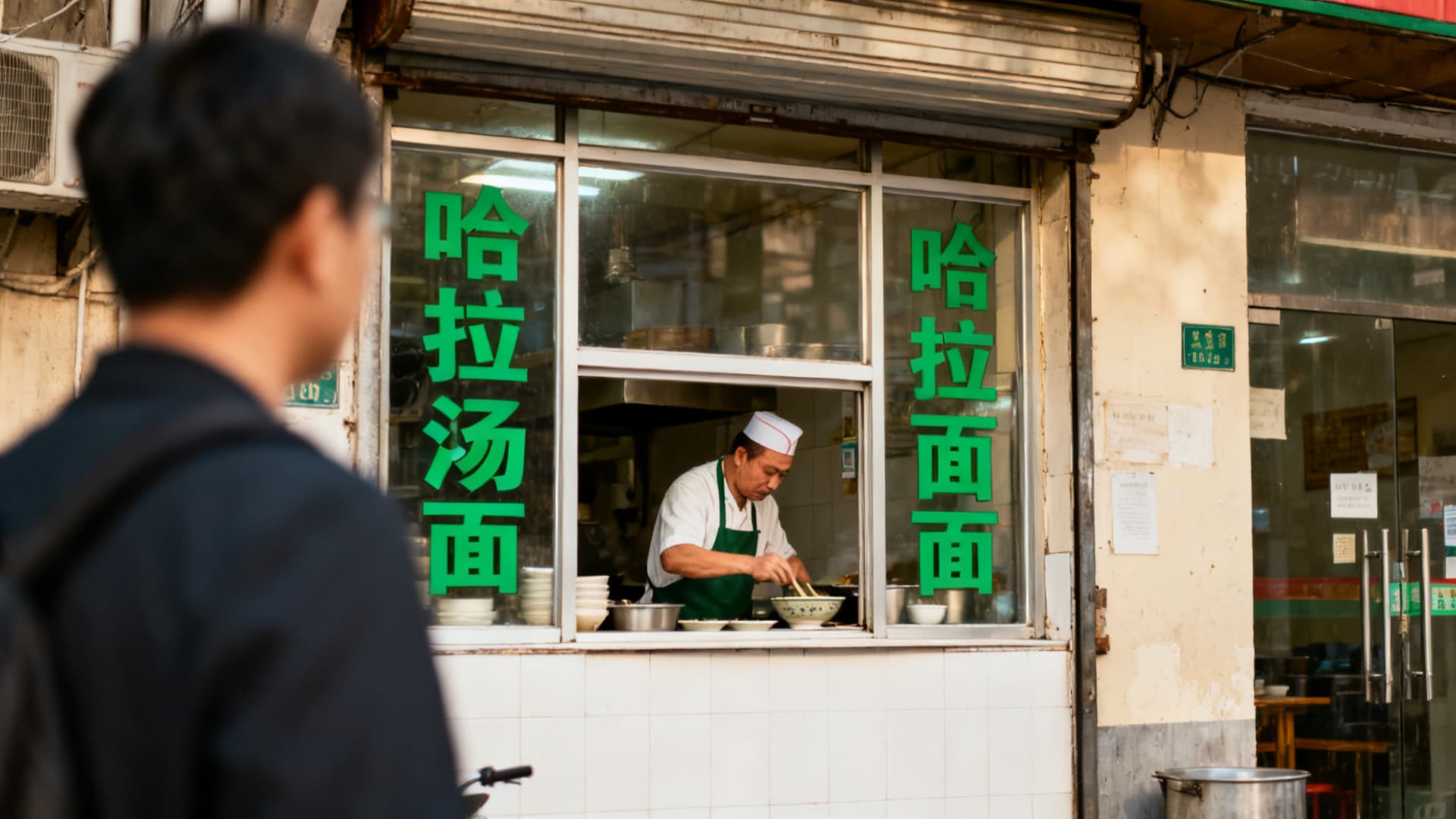
Worth knowing
A general statement does not work. “I don’t eat meat” is often understood in the kitchen as “no pieces of meat” — and you get vegetables braised in meat stock. Name the specific ingredient and say it is a matter of health or faith: then the request is taken seriously.
Halal
The key word is 清真 (qīngzhēn). It is the official halal marking in China, used on shopfront signs and on packaging in supermarkets.
There are halal eateries in practically every city, run by people from Xinjiang, Gansu and Ningxia. Usually noodles, skewers and rice with meat; search for 清真 in Dianping or straight on the map.
Large cities have mosques, and beside them there is almost always a cluster of halal places. That is the safest option if you are in doubt.
In an ordinary restaurant pork is a basic ingredient, including in mince, fillings and stock. Asking for “no pork” there is worth doing, but only 清真 gives a guarantee.
Vegetarian and vegan
The word everyone understands is 素食 (sùshí), vegetarian food. More precise still is 全素 (quán sù) — entirely free of animal products.
A separate and very reliable category is the Buddhist vegetarian restaurant, often attached to a monastery. The whole menu is meat-free by default and nothing needs explaining.
The main trap is the stock. Vegetable noodles are usually cooked in chicken or pork broth, and oyster sauce goes into stir-fried vegetables. The phrase to show: 不要肉,不要肉汤,不要蚝油 — “no meat, no meat stock, no oyster sauce”.
Tofu, mushrooms, aubergine, Chinese cabbage and root vegetables are on every menu — you will not go hungry, the question is only how they are cooked.
Allergies: how to be taken seriously
Write the phrase out in advance
Keep the Chinese text of your restriction in your notes and show it on screen. Saying it aloud is unreliable: tones matter and you may not be understood.
The basic construction is 我对…过敏 (“I am allergic to…”). Peanuts 花生, nuts 坚果, seafood 海鲜, milk 牛奶, eggs 鸡蛋, gluten 麸质.
Say that it is serious
The phrase 会很危险 (“this could be dangerous”) changes how the request is received. Food allergies are less common in China, and without that addition they are often taken as a matter of taste.
Check the sauces and the oil
Peanut oil and sesame paste are very common ingredients. With a severe allergy, plain dishes are safer: boiled, steamed, no sauces.
Carry your medication
An antihistamine, and for a severe allergy the auto-injector you have been prescribed. You will not quickly find an equivalent in a Chinese pharmacy without a prescription and without the language.
Careful
In an emergency call 120 for an ambulance. Save the address of the nearest clinic with English-speaking staff in advance: looking for it during an attack is too late.
Checked: 4 September 2026
Editor: The PANDA editorial team
What you can hand to PANDA


Sources
- PRC government portal for foreignersofficial source
- State Administration for Market Regulation of the PRCofficial source
- National Health Commission of the PRCofficial source
Didn’t find the guide you needed?
Describe it in your own words — a concierge will reply and take you through it step by step.